Residential Aged Care
 Home Services
 Community Villages
 Warrigal Social
 Other Services


Related Resources Section

Articles, FAQs, Home Services
September 26, 2025
Support Our Customers: Continuity through the Support at Home transition
Whilst the Support at Home program represents the biggest reform to aged care in decades, what stays the same is our dedicated care teams, our commitment to exceptional support, and our customers' right to live their best lives on their own terms.
At Warrigal, our vision remains unchanged: creating a world where older people feel known, loved and connected. Whilst the Support at Home program represents the biggest reform to aged care in decades, what stays the same is our dedicated care teams, our commitment to exceptional support, and our customers’ right to live their best lives on their own terms. With your continued dedication, our customers can feel confident that their care will continue to reflect what matters most to them.

About Support at Home
What is the Support at Home program?
Support at Home is a new Australian Government program launching on 1 November 2025. It will replace the current Home Care Packages (HCP) and Short-Term Restorative Care Program, with the Commonwealth Home Support Program (CHSP) transitioning no earlier than July 2027. The program represents a $4.3 billion investment aimed at providing more flexible, transparent, and comprehensive support for older Australians living at home.
Why is Support at Home being introduced?
Support at Home is a response to recommendations from the Royal Commission into Aged Care Quality and Safety. The new program is designed to give older Australians better access to services, equipment, and home modifications, so they can live independently for longer. By 2035, the Support at Home program aims to help around 1.4 million older people stay independent in their homes, supporting 300,000 more participants over the next decade.
Support at Home – What this means for our customers
Who is eligible for Support at Home?
Eligibility is determined through an assessment of customers’ care needs. If a customer is already receiving a Home Care Package, they will be transitioned to Support at Home without a new assessment. New applicants will be assessed under the new model.
What services are available under Support at Home?
All transitioned HCP clients can only access services on the Support at Home service list. If a service is being provided that is not included on the service list, we can enter into a private arrangement for the service to continue.
Services are grouped into three main categories:
- Clinical Care: Specialised services to maintain or regain functional and/or cognitive capabilities (e.g., nursing, most allied health, nutrition, care management, and restorative care management)
- Independence: Support to manage activities of daily living and loss of skills or function to live independently (e.g., personal care, social support, respite, transport, therapeutic services, assistive technologies, home modifications)
- Everyday Living: Support to keep customers in their home in a liveable state and support their independence (e.g., domestic assistance, home maintenance and repairs, meals)
It’s important to note that services we can deliver must align to the service list, and for clients assessed after 1 November 2025 to the assessment.
How much will it cost?
Our price list can be viewed here
What are the main differences between Home Care Packages and Support at Home?
Levels of Care:*
- HCP: 4 levels (max $61,440 per year)
- Support at Home: 8 levels (max $77,709 per year) plus two new short-term care pathways (Restorative Care and End-of-Life)
Service Categories:
- HCP: Specific list of services
- Support at Home: Three categories (Clinical Care, Independence, Everyday Living) with clear participant contribution rules
Clinical Services:
- HCP: May require out-of-pocket contributions
- Support at Home: 100% government-funded. Clinical care is fully funded by the government for all participants
Pricing:
- HCP: Providers set prices and may charge multiple fees
- Support at Home: From 1 November 2025 SaH providers set an all inclusive price with no separate entry, exit, or admin fees (except up to 10% care management fee)
Care Management:
- HCP: Warrigal currently caps Care Management at 19% of your budget, along with 14% of your budget for package management.
- Support at Home: You’ll have 10% deducted from your quarterly budget for Care Management. These funds will be pooled at the provider level for providers to use flexibly to deliver care management services to all clients.
Participant Contributions:
- HCP: Basic daily fee, income-tested fee, and provider fees (e.g ‘top-up’ fees)
- Support at Home: Contributions based on income/assets and service category; no contribution for clinical services. Clinical care is fully funded by the government for all participants.
Budget Allocations:
- HCP: Annual budget, paid monthly
- Support at Home: Quarterly budgets with limited rollover
Unspent Funds:
- HCP: Participants who were receiving a Home Care Package and had unspent funds as of 30 June 2025 will retain their unspent funds for use in their Support at Home quarterly budget.
- Support at Home: Recipients who have not spent their budget within the quarter will be able to accrue a maximum of $1,000 or 10% of their quarterly budget, (whichever is higher,) from one quarter to the next.
Assistive Technology & Home Modifications:
- HCP: Funded from your package. Currently, all recipients need to save up package funds to fund Assistive tech or home modification needs.
- Support at Home: Separate, immediate funding (up to $15,000 depending on tier)
What are the new short-term care options?
- Restorative Care: Up to 12 weeks of support, $6,000 budget
- End-of-Life Care: Up to $25,000 over 16 weeks for those who wish to remain at home
*Transitioned HCP care recipients who have not been reassessed under Support at Home continue to receive an equivalent level of funding (including supplements) as their previous Home Care Package. The previous annual package amount is divided into four to create the recipient’s equivalent Support at Home quarterly budget. Funding amounts for transitioned HCP care recipients are outlined in the Schedule of Subsidies and Supplements for Aged Care. Funding amounts are indicative and are subject to indexation revisions. Older people who, on 30 June 2025, were on the National Priority System or assessed as eligible for a Home Care Package will transition to Support at Home when funding becomes available. These participants will receive an equivalent level of funding to their approved HCP.
What is the “No Worse Off” principle?
The government has established a “no worse off” principle for people who, on 12 September 2024, were either receiving a package, on the National Priority System, or assessed as eligible for a package. These care recipients will make the same contributions, or lower, than they would have had under Home Care arrangements. These contributions relate only to the out-of-pocket client contributions, not the individual process for services.
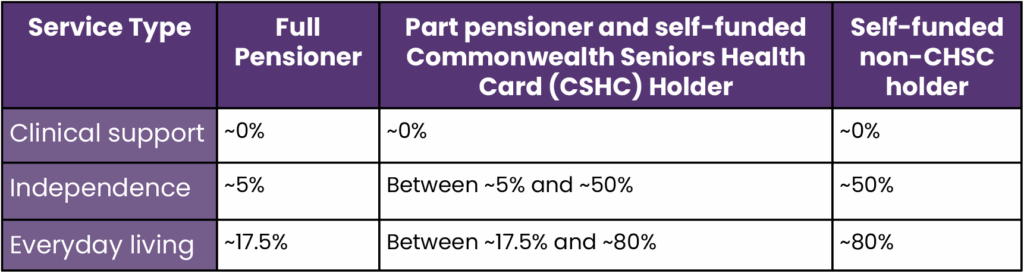
How will Participant Contributions work under Support at Home?
Support at Home focuses government funding on services that help maintain our customers wellbeing within their own home environment, reducing the need for hospital admissions.
This approach recognises that our customers will continue to contribute towards daily living expenses and services they have traditionally managed over the course of their lives. Their contribution levels are calculated according to their financial circumstances and the specific types of support they receive.
Service Changes
How will third-party services work under Support at Home?
Under Support at Home, third-party service compliance and oversight requirements have increased, and as a result, the way third-party services are managed has changed with an increase in compliance and oversight requirements of those third party services. Previously, some costs were charged separately. Now, pricing must be agreed up front, with a 10% overhead cap per invoice, for administrative functions and oversight where the client has chosen the third-party service.
How do travel charges work under Support at Home?
Under the new program, travel costs are now included in service rates rather than charged separately. This change makes pricing more transparent and aligns with government requirements. The services you receive remain the same, they’re just shown differently in the pricing structure.
What can customers be reimbursed for under Support at Home?
Customers can be reimbursed for:
- Services or items on the Support at Home service list
- Assistive technology products (if on the AT-HM list)
- Services they’re approved to receive in their care plan*
There are specific requirements for reimbursements under Support at Home, so these need to be agreed to, budgeted, and documented up front.
Can customers be reimbursed for taxi or rideshare fares?
No, customers cannot be reimbursed for taxi or rideshare fares paid directly out of pocket. Transport services must be provided as vouchers (such as Cabcharge) issued by Warrigal. For more information, please see the information at this link: support-at-home-service-list-faqs.pdf
Cancellations and Service Delivery
What is the policy for late cancellations?
A late cancellation occurs when a customer provides less than 2 business days’ notice of a cancellation to a scheduled service.
What counts as a ‘no-show’?
A ‘no-show’ occurs when a customer is not present at the agreed place and time for a scheduled service.
What are reasonable grounds for cancellations?
Reasonable grounds include:
- The customer was in hospital
- The customer was experiencing a health incident
- The customer’s informal support arrangements changed unexpectedly
How should I handle cancellation situations?
Each situation should be considered on a case-by-case basis. If a customer claims reasonable grounds, they should provide written evidence. Report the situation to your coordinator for appropriate handling.
Support and Communication
How can I get more information or ask questions?
If you have questions about Support at Home that you can’t answer, or if customers have complex enquiries, you have clear pathways for support:
For customer enquiries about Support at Home:
- Direct customers to contact: supportathome@warrigal.com.au
- Or they can speak with their senior coordinator
For your own questions as a staff member:
- Speak with your line manager
- Contact HR for qualification questions: hr@warrigal.com.au
- Contact general enquiries: warrigal@warrigal.com.au
Remember: You don’t need to have all the answers. When customers ask complex questions about budgets, care plans, or specific Support at Home requirements, it’s perfectly appropriate – and encouraged – to direct them to our specialist team at supportathome@warrigal.com.au. This team has the most current information and can provide personalised responses to individual circumstances.
FAQs
August 26, 2026
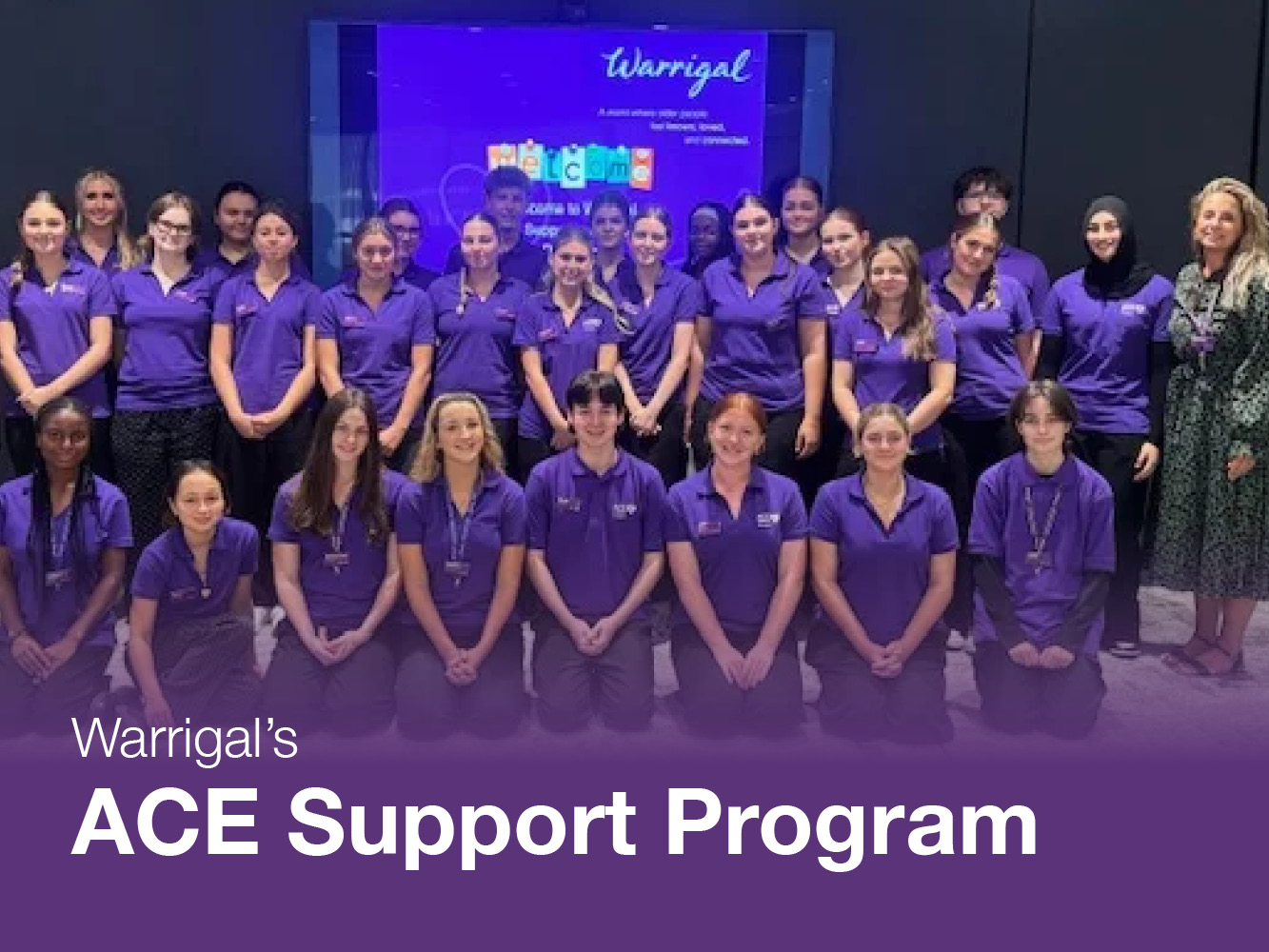
At Warrigal, we offer an Assistant Care Employee Support Program, designed for students aged 16-25 years who are completing their final years of high school or university, and are interested in a pathway to the health industry while studying.

FAQs, Guides, Residential Aged Care
August 6, 2026
Our new Matterport virtual tours provide prospective residents and their loved ones with the opportunity to explore our residential aged care homes remotely.
Articles, Blog Posts
July 29, 2026
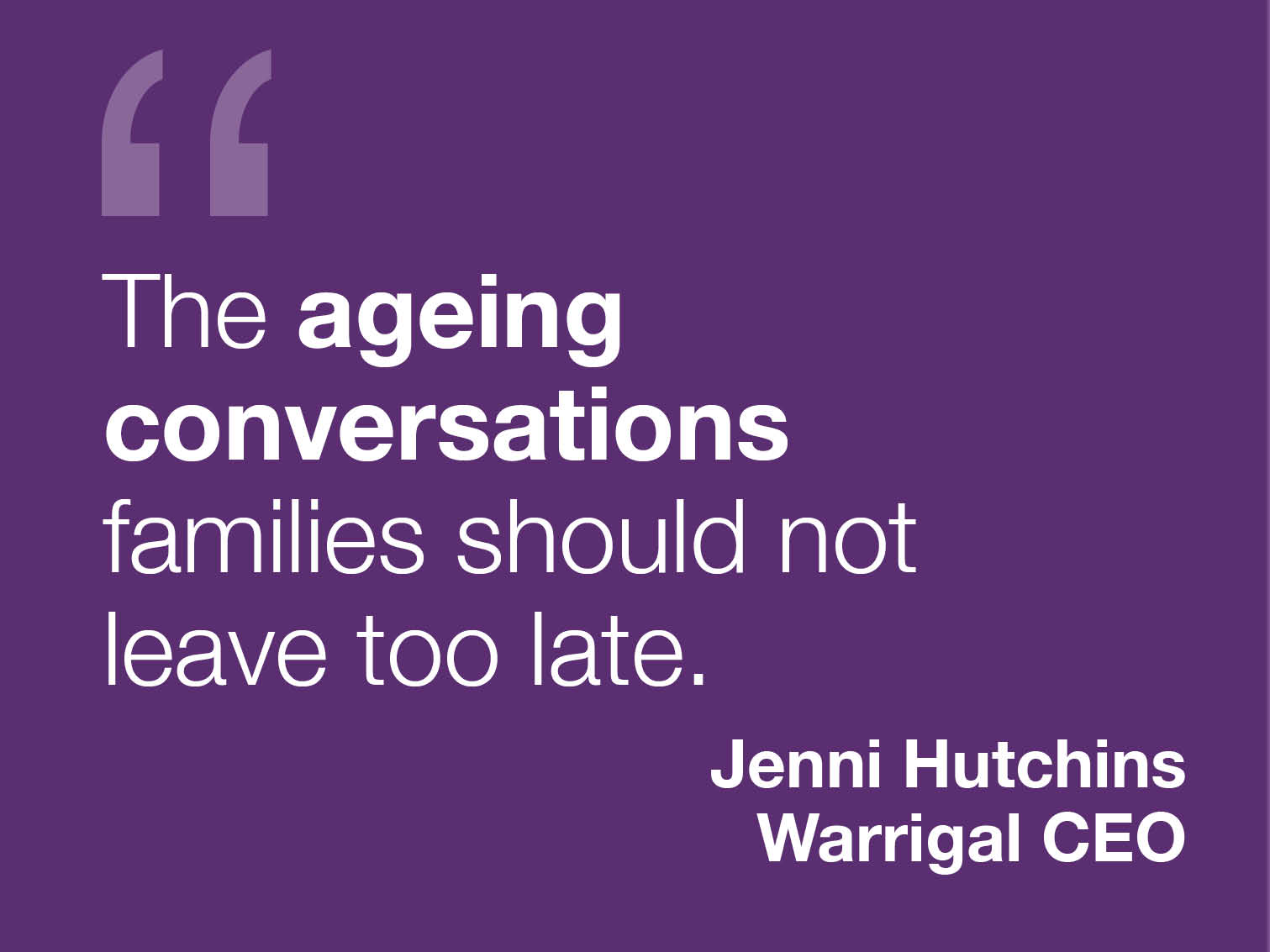
Our Warrigal CEO Jenni Hutchins recently wrote an op-ed for the Illawarra Mercury. Read her insight into the ageing conversation that families should not leave too late.